Publication 69 · Thermal convection
What rotation rate maximizes heat transport in rotating Rayleigh-Bénard convection with Prandtl number larger than one?
Y. Yang, R. Verzicco, D. Lohse, R.J.A.M. Stevens, Phys. Rev. Fluids 5, 053501 (2020).
Read the article Open-access version (university repository)
Main finding
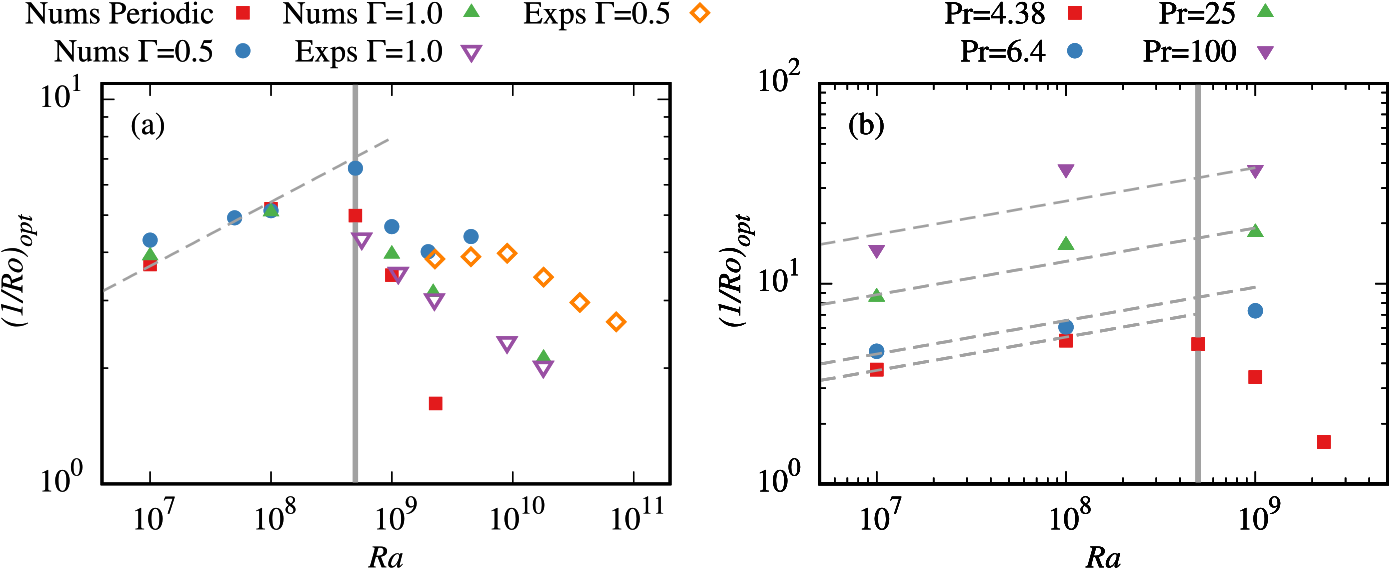
The rotation rate giving maximum heat transport falls into two regimes in the simulated convection, with a supported scaling at low Rayleigh number. The high-Rayleigh-number mechanism and transfer beyond the tested matrix remain provisional.
Why this matters
Moderate rotation has an optimum, and that optimum changes when turbulence disrupts coherent vortices.
Research context
Earlier work establishes the rotation-induced transition and the Prandtl-number optimum. This paper maps the optimal rotation rate across Rayleigh number; later confinement studies add a second control parameter, while large-Rayleigh-number analysis extends the dataset to test how the optimum changes regime.
View in the complete publication list Related thermal convection research