Welcome
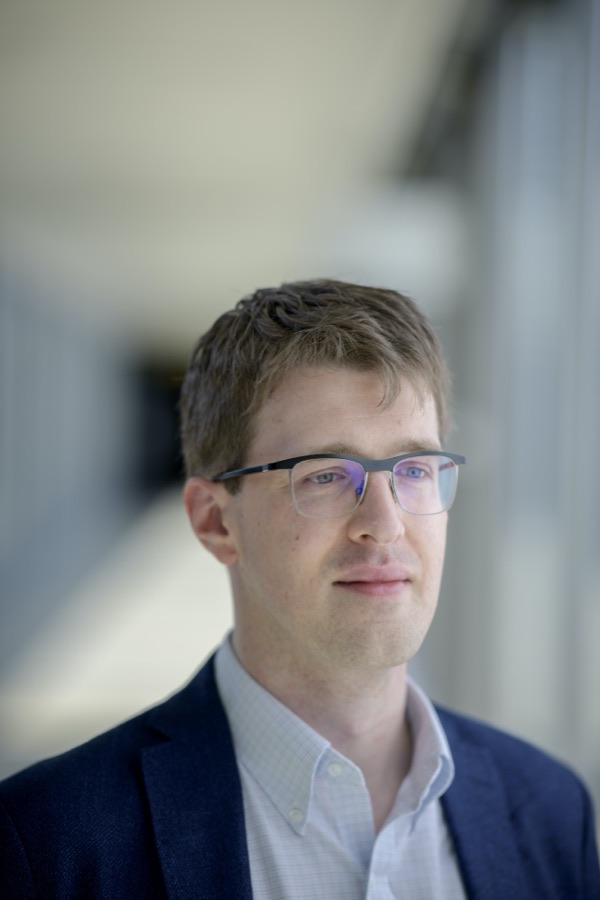
I am a faculty member of the Physics of Fluids group at the University of Twente in the Netherlands. The group belongs to the Faculty of Science and Technology and is embedded in the Max Planck Center Twente.
Richard J.A.M. Stevens is a professor in the Physics of Fluids group at the University of Twente. His research focuses on turbulence, atmospheric boundary layers, the flow physics of wind farms, and high-fidelity numerical simulation. Using large-scale simulations and physics-based models, his group studies how turbulent flows transport momentum, heat, and mass across a wide range of spatial and temporal scales. A central aim is to connect fundamental turbulence physics to improved prediction and design of wind-energy systems.
Research
Turbulence plays a central role in almost all natural and engineering flows, yet many of the mechanisms governing turbulent transport and multiscale interactions remain incompletely understood. The group uses Direct Numerical Simulation (DNS), Large Eddy Simulation (LES), analytical modeling, and high-performance computing to study these processes under both idealized and realistic conditions. DNS resolves the dynamically relevant turbulent scales and provides detailed reference data, while LES makes it possible to investigate atmospheric and wind-farm flows over domains and time scales that are inaccessible to fully resolved simulations.
A major research area is the atmospheric boundary layer: the lowest part of the atmosphere, where wind, turbulence, temperature, moisture, clouds, and the Earth's surface continuously interact. The group investigates how atmospheric stability, low-level jets, large-scale pressure gradients, baroclinicity, weather variability, and surface conditions influence turbulent momentum transport and local wind resources. These processes determine the inflow experienced by wind turbines and strongly affect power production, structural loading, wake recovery, and the collective behavior of large wind farms.
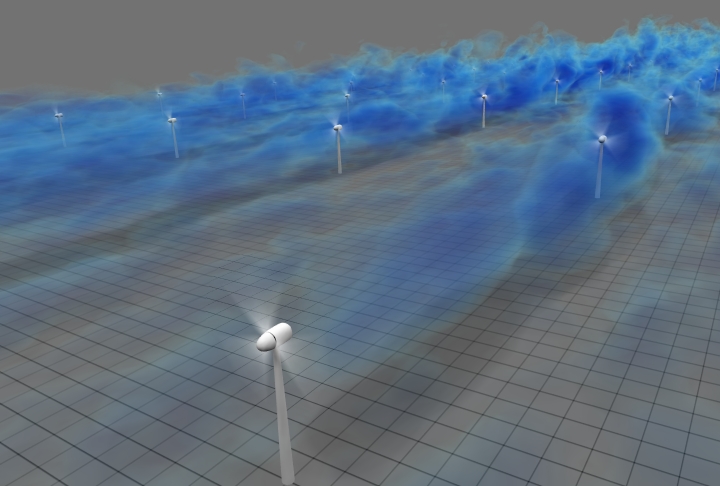
The group also studies the flow physics of wind farms across turbine, farm, and atmospheric scales. This includes how turbine wakes form, interact, and recover; how turbine spacing and layout affect energy extraction; how wakes merge into farm-scale flow structures; and how entire wind farms modify the atmospheric boundary layer. Particular attention is given to the mechanisms that transport kinetic energy into the turbine region, the transition from turbine-scale to farm-scale wake recovery, and the role of atmospheric motions in wind-farm power variability. These insights support the development of improved reduced-order models, more accurate power predictions, and more efficient strategies for wind-farm design and operation.
Beyond wind energy, the group studies fundamental problems in turbulent boundary layers, thermal convection, rotating flows, and other canonical fluid systems. These controlled configurations make it possible to isolate physical mechanisms, test scaling theories, investigate coherent structures, and evaluate numerical methods. Work on canonical turbulence also provides the physical and computational foundation for the more complex simulations used in atmospheric and wind-energy research.
High-Performance Computing
The group's simulations are among the most detailed numerical flow calculations currently feasible and can contain up to billions of computational cells. National and international supercomputing facilities make it possible to study turbulent processes over broad ranges of Reynolds number, spatial scale, and simulation time. This enables direct investigation of flow phenomena that are difficult to isolate experimentally, while also providing high-quality data for model development, validation, and reduced-order descriptions.
The group develops and uses efficient numerical methods and scalable simulation software for modern high-performance computing systems. This includes AFiD, an open-source framework for large-scale Direct Numerical Simulations of canonical turbulent flows such as Rayleigh-Bénard convection, Taylor-Couette flow, channel flow, and plane Couette flow. These computational tools support both fundamental turbulence research and the development of models for more complex atmospheric and wind-energy applications.
Collaboration
The research is carried out in close collaboration with national and international universities, research institutes, and industrial partners. These collaborations combine expertise in fluid mechanics, atmospheric science, wind-energy engineering, applied mathematics, acoustics, and scientific computing. The overall research program connects fundamental turbulence physics with applications in renewable energy, atmospheric modeling, wind-farm prediction, flow control, and high-performance simulation. More detail is available on the research and publications pages.
Research themes
Wind-farm flow physics
Large-eddy simulation of how wind-turbine wakes interact, merge, and recover inside large wind farms, and how this interaction sets the overall power output.
Analytical wind-farm modeling
Physics-based and reduced-order models that connect wake dynamics, boundary-layer theory, and farm-scale behavior to wind-farm performance, without the cost of full simulation.
Atmospheric boundary layers and turbulent boundary layer flow
Structure and scaling of turbulent boundary layers, including how atmospheric stability, shear, and stratification couple to wind-farm wake recovery and power production.
Turbulent convection and rotating convection
Direct numerical simulation of heat and momentum transport in Rayleigh-Bénard convection, including how background rotation modifies turbulent heat transport and flow structure.
Open-source simulation tools (AFiD)
Development and use of AFiD, an open-source high-performance code for direct numerical simulation of canonical turbulent flows such as Rayleigh-Bénard convection, Taylor-Couette flow, and channel flow.
Visualizations of these simulations are collected on the research highlights page.
Contact Information
Dr. ir. Richard J.A.M. Stevens
Physics of Fluids group
Faculty of Science and Technology
University of Twente
Building Meander
P.O. Box 217
7500 AE Enschede
The Netherlands
T: +31 (0)53 489 5359
E: r.j.a.m.stevens@utwente.nl