Publication 17 · Thermal convection
Breakdown of the large-scale circulation in Γ = 1/2 rotating Rayleigh-Bénard flow
R.J.A.M. Stevens, H.J.H. Clercx, D. Lohse, Phys. Rev. E 86, 056311 (2012).
Read the article Open-access version
Main finding
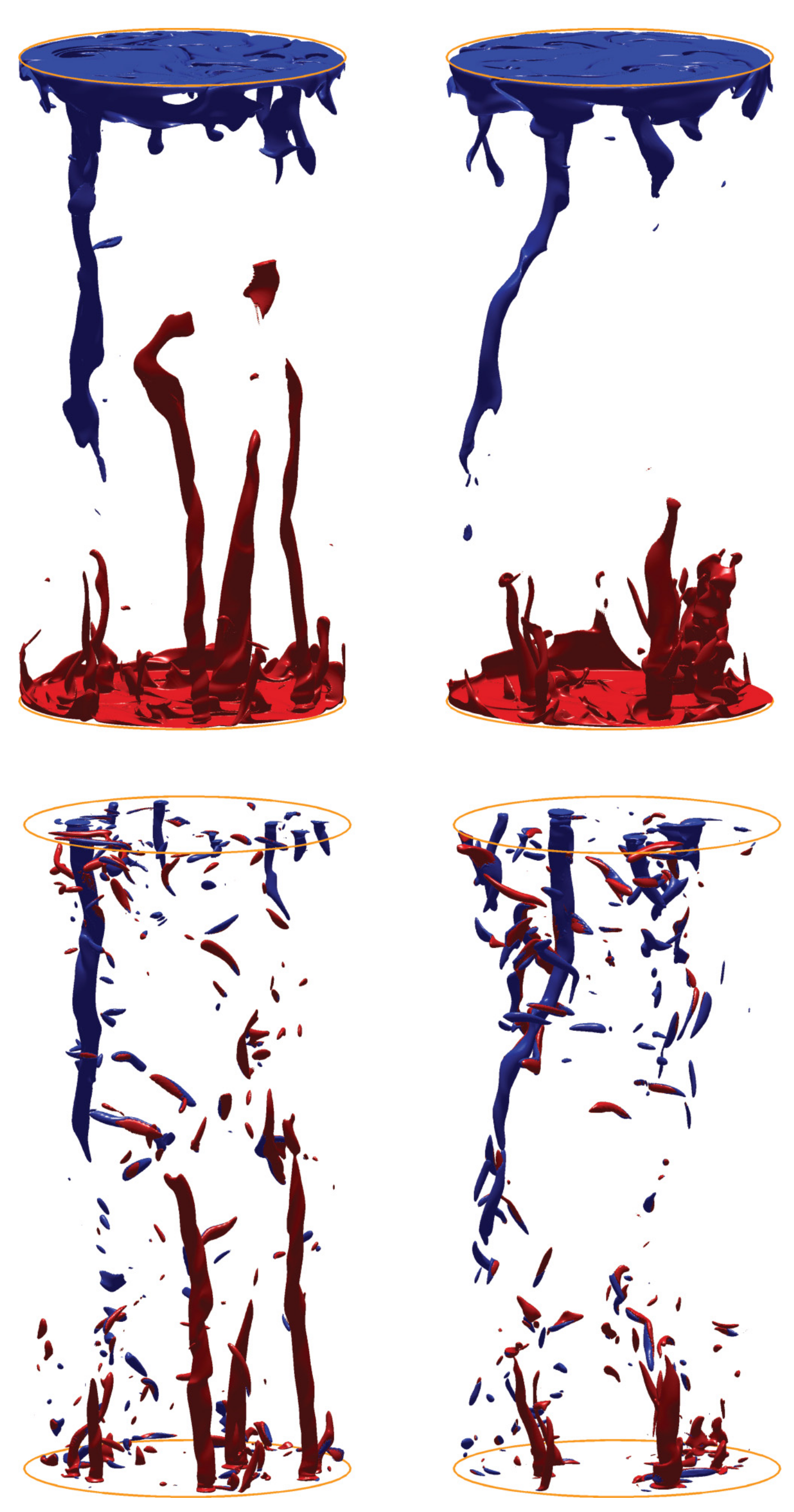
The observed post-transition state is neither a single roll nor the simple two-vortex topology proposed from sparse probes. It is a collection of vertically aligned vortices whose time-averaged organization mimics an LSC temperature signature. Temperature isosurfaces and the three-dimensional Q criterion agree on the dominant vortex tubes; small interior vortices can be missed by the temperature criterion.
Why this matters
The result demonstrates that a persistent sinusoidal sidewall-temperature signal is not a unique identifier of the underlying flow topology.
Research context
The study directly applies the diagnostic cautions introduced by the plume-measurement analysis (read the finding) and complements the later two-threshold Lagrangian study (read the finding). Its central warning is that a persistent sidewall-temperature mode does not uniquely identify the three-dimensional flow state.
View in the complete publication list Related thermal convection research