Publication 98 · Wind-farm flow
Evaluating the accuracy of the actuator line model against blade element momentum theory in uniform inflow
L. Liu, L. Franceschini, D.F. Oliveira, F.C.C. Galeazzo, B.S. Carmo, R.J.A.M. Stevens, Wind Energy 25 (6), 1046-1059 (2022).
Main finding
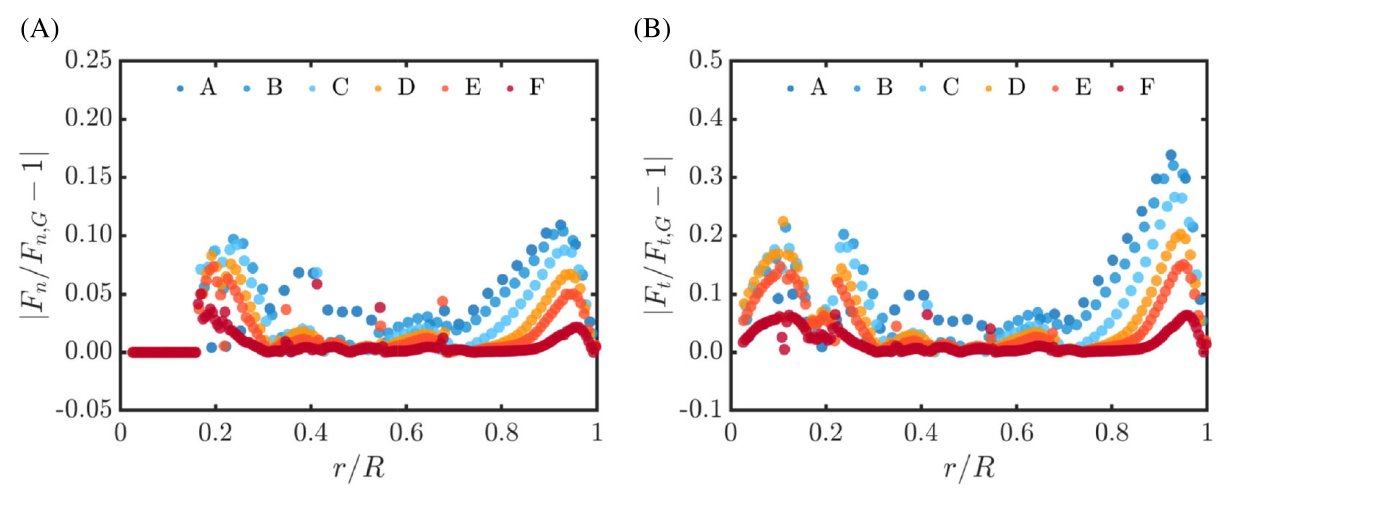
Integrated actuator-line loads, local blade loading and wake-vortex fields require different levels of numerical resolution. Matching integrated coefficients therefore does not establish local accuracy or one universal resolution criterion.
Why this matters
Matching integrated actuator-line loads does not guarantee accurate spanwise loading, turbulence, or wake-vortex structure.
Research context
Earlier coarse-grid work (read the finding) identifies projection-kernel bias, while wind-tunnel comparisons show that wake-model accuracy depends on the chosen metric. Subsequent tip-loading work (read the finding) adds a sampled-velocity correction, and yawed-vortex simulations examine structure beyond integrated loads.
View in the complete publication list Related wind-farm research