Publication 22 · Wall-bounded and rotating shear turbulence
Optimal Taylor-Couette flow
R. Ostilla-Mónico, R.J.A.M. Stevens, S. Grossmann, R. Verzicco, D. Lohse, J. Fluid Mech. 719, 14-46 (2013).
Read the article Open-access version (university repository)
Main finding
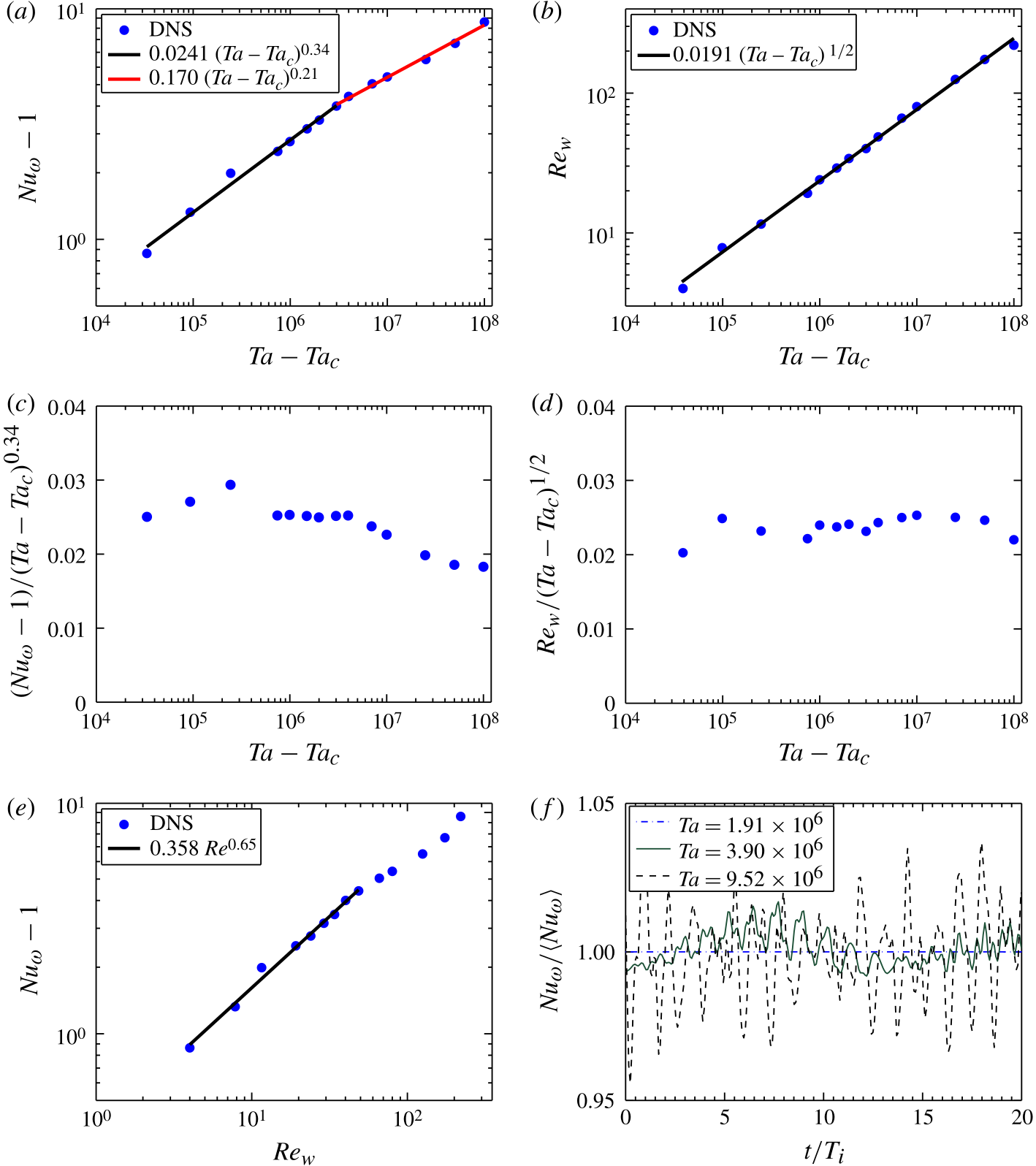
For pure inner-cylinder rotation, Nu_omega - 1 changes from an effective exponent near 0.34 below Ta ≈ 2–3 × 10^6 to about 0.21 above it, while Re_w retains square-root scaling. Increasing driving weakens the dominance of coherent Taylor vortices; rolls remain present but contribute a smaller fraction of total transport.
Why this matters
Counter-rotation can tune torque by reorganizing the neutral surface, Taylor rolls, bulk mixing, and angular-velocity profile.
Research context
The study establishes a transport–structure framework for later Taylor–Couette work on roughness, mean profiles, spiral turbulence, and particles. Counter-rotation changes the neutral surface and roll organization, which in turn changes bulk mixing, profile flatness, and torque.
View in the complete publication list Related Taylor-Couette research