Publication 49 · Thermal convection
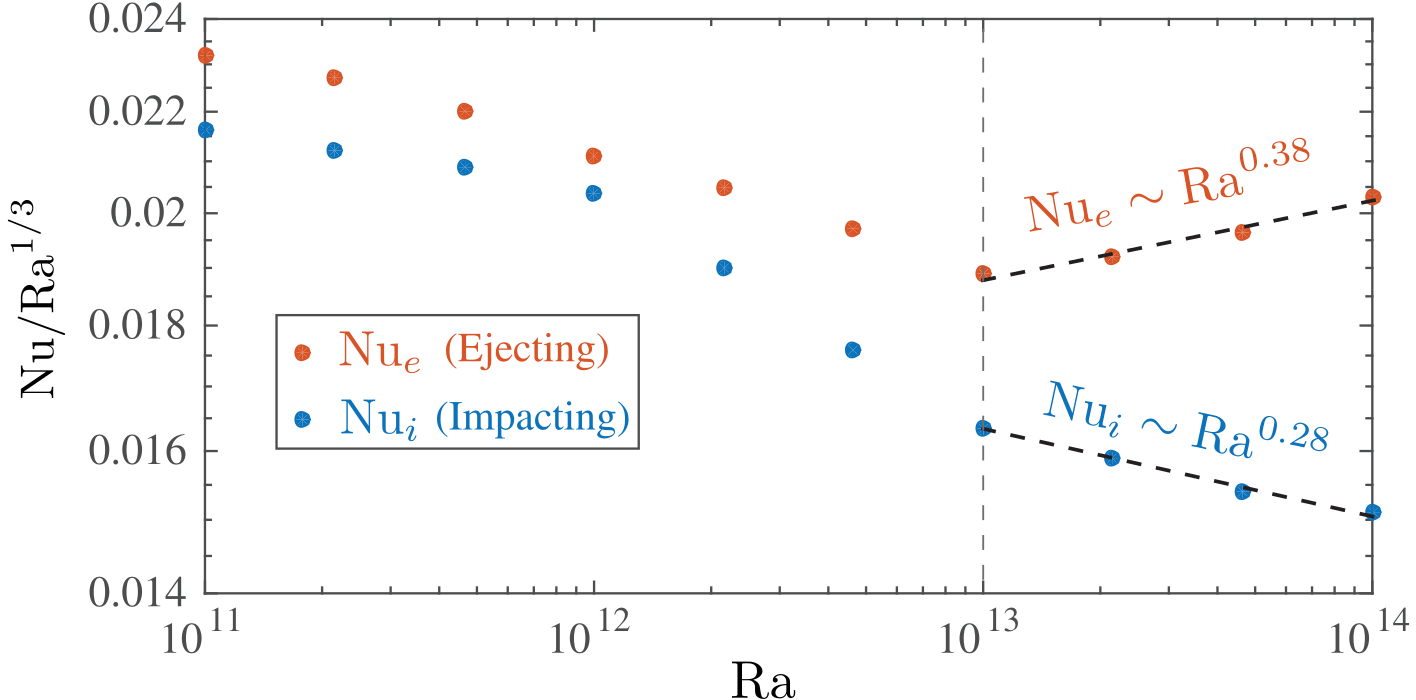
Transition to the ultimate regime in two-dimensional Rayleigh-Bénard convection
X. Zhu, V. Mathai, R.J.A.M. Stevens, R. Verzicco, and D. Lohse, Phys. Rev. Lett. 120, 144502 (2018).
Read the article Open-access version
Main finding
The Letter supplies a coherent multi-diagnostic candidate transition near Ra=10^13, stronger than an exponent-only claim. It does not by itself uniquely establish turbulent boundary layers or an ultimate regime because the profile fits, breakpoint, numerical fidelity, uncertainty, state sensitivity, conditional decomposition, and later formal dispute remain unresolved.
Why this matters
Different wall regions can change differently as convection intensifies, producing a gradual global transition.
Research context
Earlier roughness evidence: Roughness-facilitated local 1/2 scaling does not imply the onset… (read the finding) shows that a local near-half-power interval under mono-scale roughness does not imply the ultimate regime; Nu ∼ Ra^1/2 scaling enabled by multiscale wall roughness… (read the finding) extends that finite interval with multiscale roughness. These rough cases do not validate the smooth-wall transition claimed here.
View in the complete publication list Related thermal convection research