Publication 106 · Wind-energy acoustics
Wind turbine sound propagation
J. Colas, A. Emmanuelli, D. Dragna, P. Blanc-Benon, B. Cotté, R.J.A.M. Stevens, J. Acoust. Soc. Am. 154, 1413–1426 (2023).
Read the article Open-access version
Main finding
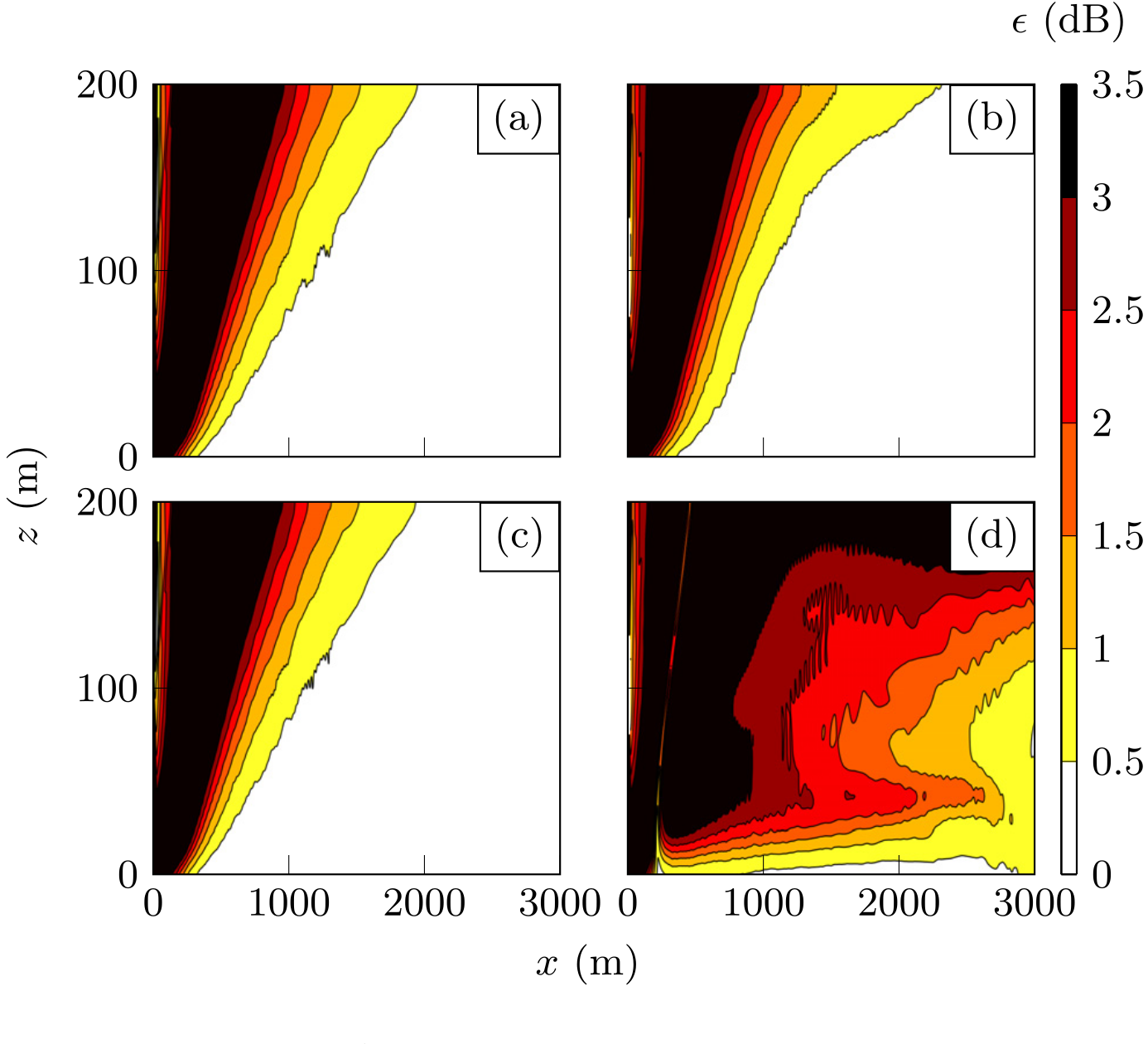
Parabolic-equation and linearized-Euler calculations can agree on broadband overall turbine sound levels while differing in frequency-resolved details in the two tested cases. Terrain and propagation-angle limits remain material; neither solver is validated generally.
Why this matters
Different propagation models can agree on overall level while disagreeing locally.
Research context
Effects of Two-Dimensional Steep Hills on the Performance of… (read the finding) supplies the terrain LES; Effect of a 2D Hill on the Propagation of… introduces the moving-frame terrain LEE and point-source cases. A later extension, Impact of a Two-Dimensional Steep Hill on Wind Turbine… (read the finding), applies the verified LEE workflow to all six terrain/wake cases, source-height and wind-speed effects, an extended moving source, and comparison with contrary terrain studies.