Publication 5 · Thermal convection
Boundary layer structure in turbulent thermal convection and its consequences for the required numerical resolution
O. Shishkina, R.J.A.M. Stevens, S. Grossmann, D. Lohse, New J. Phys. 12, 075022 (2010).
Read the article Open-access version
Main finding
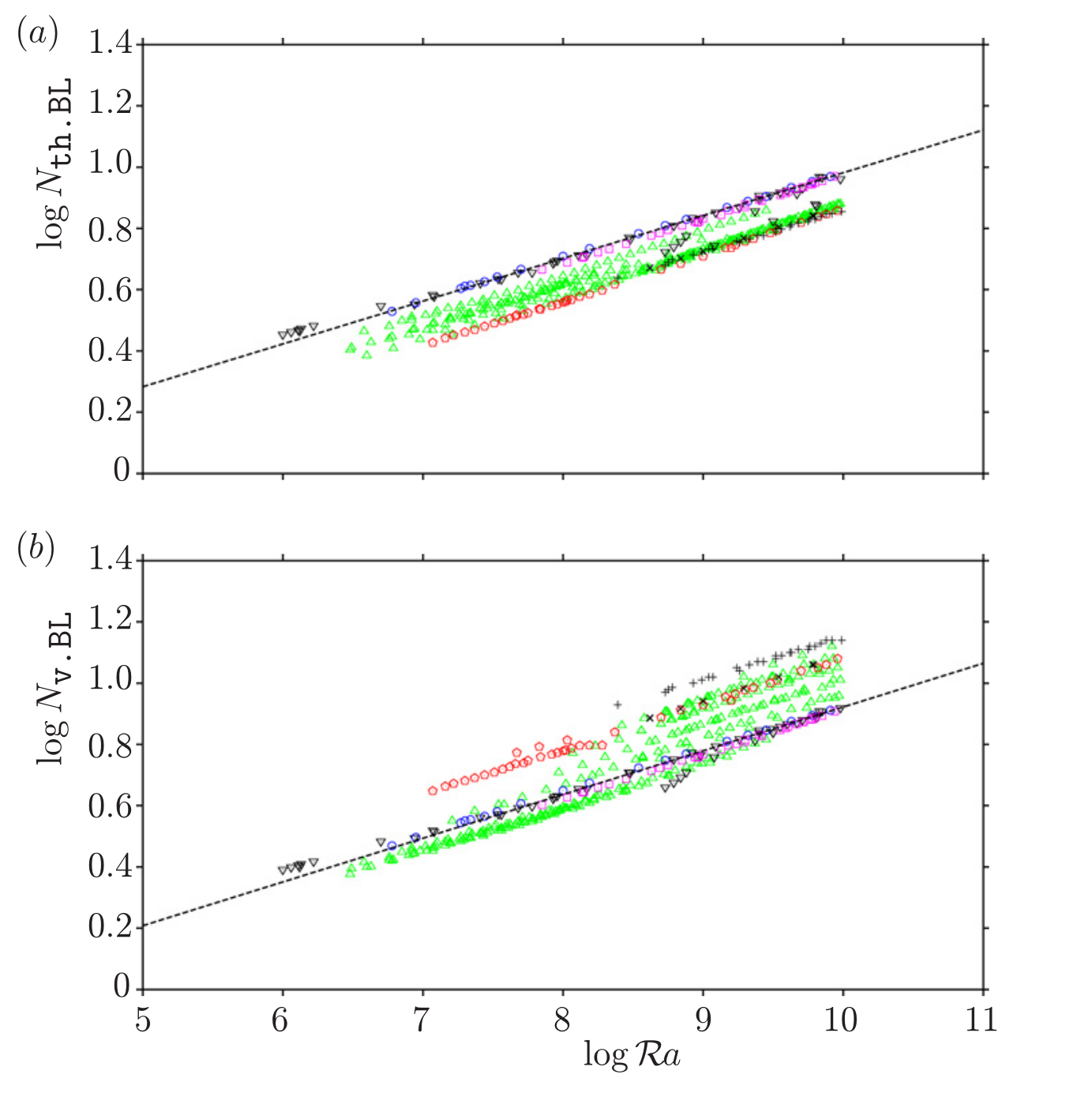
Boundary-layer thickness and local dissipation estimates provide a lower-bound grid-design rule for convection DNS. Satisfying the proposed node-count equations does not by itself guarantee an accurate simulation.
Why this matters
Finer near-wall resolution is needed as turbulent heat transport intensifies.
Research context
Grossmann–Lohse scaling and classical Prandtl–Blasius theory provide the analytical framework. Radial boundary layer structure and Nusselt number in Rayleigh-Bénard… (read the finding) supplies the reused cylindrical DNS thickness diagnostic and empirical grid-sensitivity context; Optimal Prandtl number for heat transfer in rotating Rayleigh-Bénard… (read the finding) uses related kinetic/thermal boundary-layer diagnostics. Later or parallel papers that extend, revise, or test it: Prandtl-Blasius temperature and velocity boundary layer profiles in turbulent… (read the finding) tests dynamically rescaled temperature and velocity profiles against Prandtl–Blasius forms; Horizontal structures of velocity and temperature boundary layers in… (read the finding) resolves horizontal structure in 2D DNS; Comparison of computational codes for direct numerical simulations of… (read the finding) compares independent computational codes.
View in the complete publication list Related thermal convection research