Publication 7 · Thermal convection
Radial boundary layer structure and Nusselt number in Rayleigh-Bénard convection
R.J.A.M. Stevens, R. Verzicco, D. Lohse, J. Fluid Mech. 643, 495-507 (2010).
Read the article Open-access version (arXiv manuscript)
Main finding
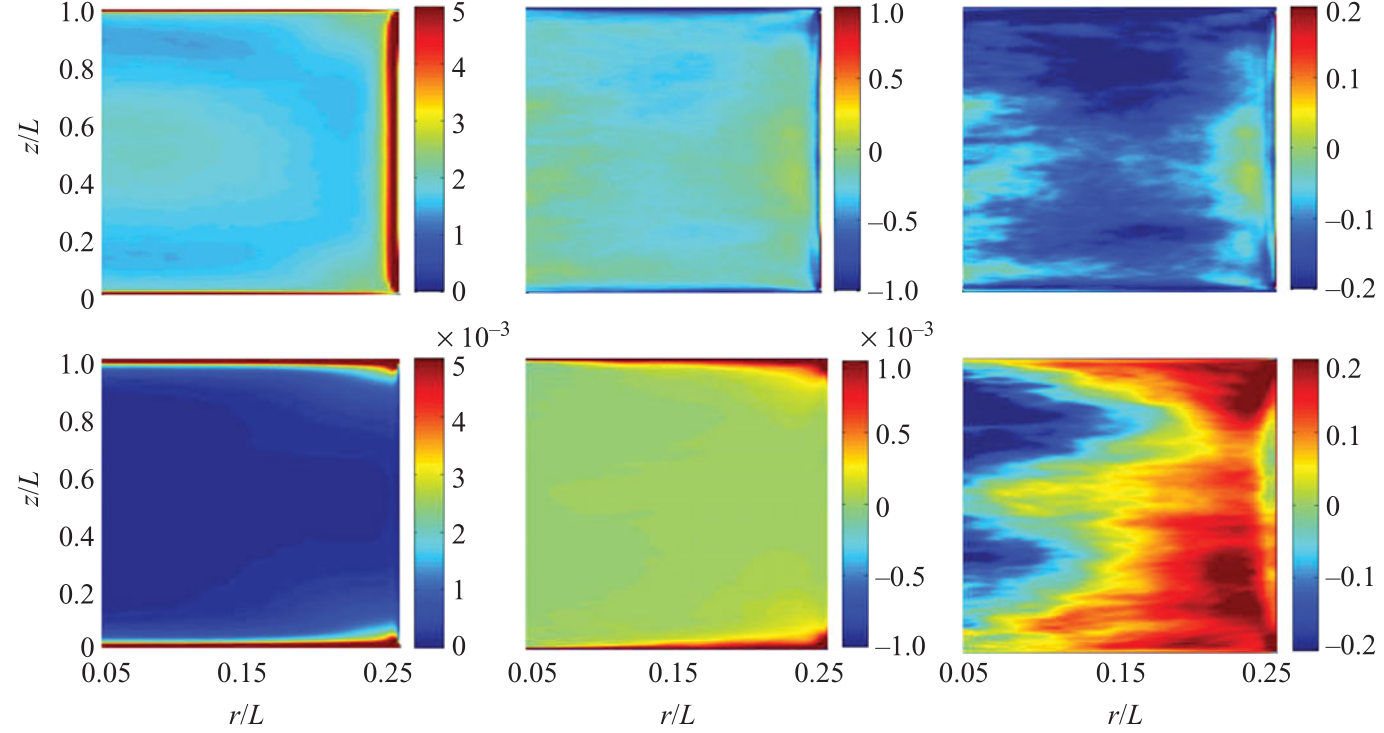
Agreement in global Nusselt number can conceal local under-resolution in convection DNS, especially in sidewall plumes. Local resolution and thermal balance must be checked; the study does not prove all tabulated finest grids fully resolved or one universal resolution formula.
Why this matters
A plausible global answer can hide unresolved local physics.
Research context
Verzicco–Camussi/Amati DNS supplies the disputed high-Nu lineage; Prandtl-, Rayleigh-, and Rossby-Number dependence of heat transport in… (read the finding) supplies the imported Γ=1 multi-Pr comparison and related code lineage. Later and parallel papers: Boundary layer structure in turbulent thermal convection and its… (read the finding) formalizes resolution guidance partly from this campaign; Prandtl-Blasius temperature and velocity boundary layer profiles in turbulent… (read the finding) and Horizontal structures of velocity and temperature boundary layers in… (read the finding) test PB profiles under dynamic rescaling; Comparison of computational codes for direct numerical simulations of… (read the finding) later demonstrates across codes that plausible Nu can conceal local under-resolution. Boundary layers in rotating weakly turbulent Rayleigh-Bénard convection (read the finding) uses related boundary-layer diagnostics in rotating convection.
Related findings: Turbulent thermal superstructures in Rayleigh-Bénard convection; How wide must Rayleigh–Bénard cells be to prevent finite aspect ratio effects in turbulent flow?.
View in the complete publication list Related thermal convection research