Publication 18 · Thermal convection
Thermal boundary layer profiles in turbulent Rayleigh-Bénard convection in a cylindrical sample
R.J.A.M. Stevens, Q. Zhou, S. Grossmann, R. Verzicco, K.-Q Xia, D. Lohse, Phys. Rev. E 85, 027301 (2012).
Read the article Open-access version
Main finding
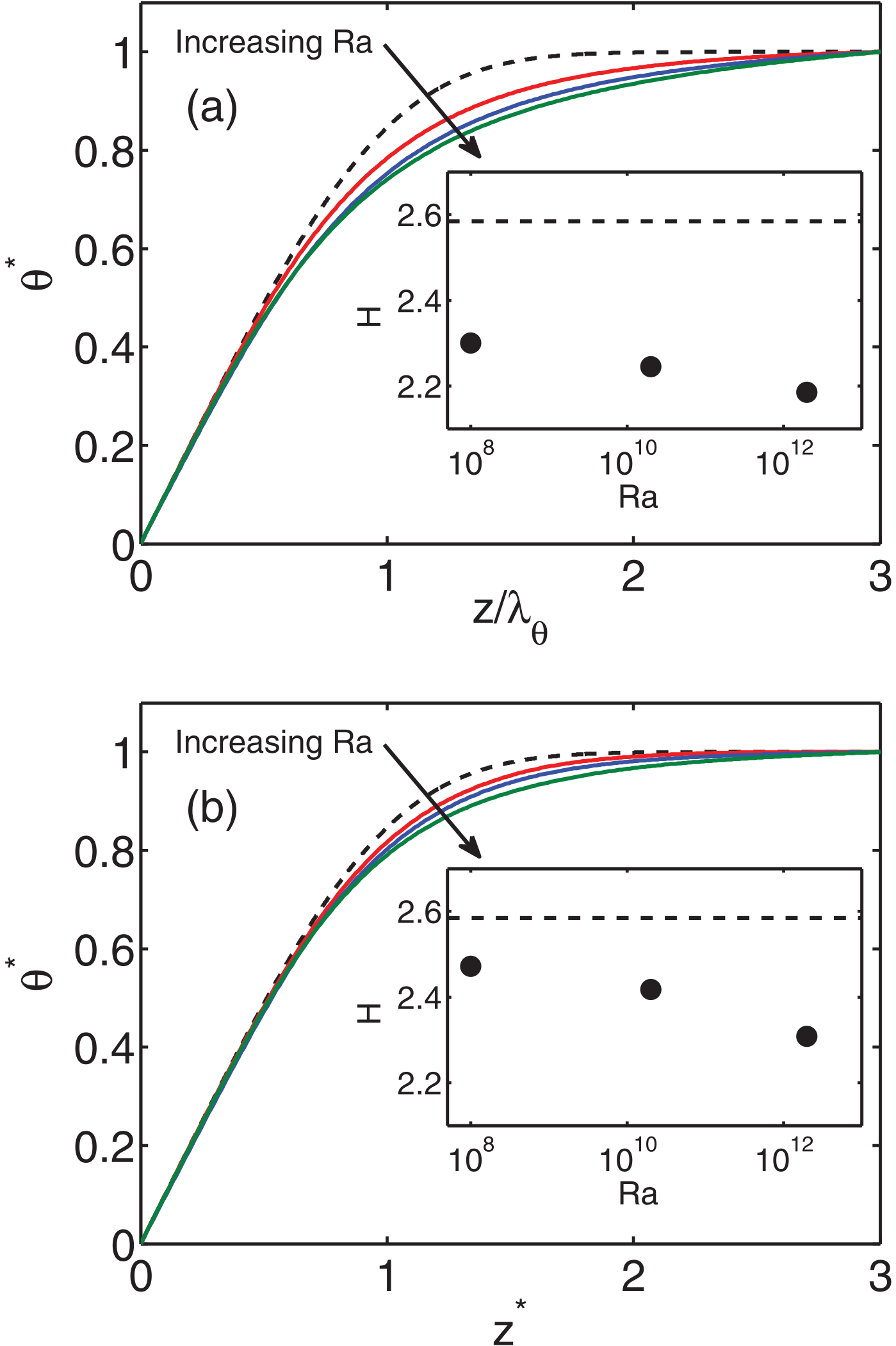
Following instantaneous boundary-layer thickness brings centre-axis mean temperature profiles closer to Prandtl–Blasius form in the sampled convection. Dynamic rescaling alone does not validate laminar Pohlhausen physics, establish full resolution or isolate the remaining deviations.
Why this matters
A moving coordinate can reveal structure hidden by averaging.
Research context
Prandtl-Blasius temperature and velocity boundary layer profiles in turbulent… (read the finding) and Horizontal structures of velocity and temperature boundary layers in… (read the finding) establish the dynamic-rescaling method in quasi-two-dimensional data and already show its normalization, shape-factor, dimensionality, selection, and causal limits. Radial boundary layer structure and Nusselt number in Rayleigh-Bénard… (read the finding), Prandtl and Rayleigh number dependence of heat transport in… (read the finding), and Effect of plumes on measuring the large scale circulation… (read the finding) supply the reused three-dimensional simulations; only Radial boundary layer structure and Nusselt number in Rayleigh-Bénard… currently has a detailed baseline. That paper also shows radial and numerical-fidelity dependence in the same code family. Logarithmic temperature profiles in turbulent Rayleigh-Bénard convection (read the finding) finds log-compatible bulk profiles near the sidewall at different vertical ranges and regime coverage.
View in the complete publication list Related thermal convection research